Worried you’ll look clumsy on the water? Learning how to cast a fly rod comes down to this: bend the rod with a smooth build of speed, stop it sharply, and let the line carry the fly.
This lesson sits inside the wider fly fishing topic on this site, so start there if you want the big picture.
| Item | Value |
|---|---|
| Daily practice | 15 minutes a day over a summer or fall season |
| Distance where many fish are caught | 10 to 30 feet |
| Line to start with | 10 to 15 feet |
| Short-stroke rod range | Between 1 o’clock and 11 o’clock |
| Classic older teaching arc | 10 o’clock to 2 o’clock |
These figures come from Fly Fisherman’s casting guide and Bass Pro Shops’ overhead cast guide. Guidance can be revised, so check the source before you rely on them.
Set up before your first cast
Pick an open spot with nothing above eye level. The Bass Pro Shops guide warns that few things hurt confidence more than a new fly line wrapped around a telephone or power line.
Stand with your feet about shoulder width apart. If you are right-handed, the same guide puts your right foot slightly ahead of your left.
Start with the rod tip touching the ground and roughly 10 to 15 feet of line lying straight out in front of you, as that guide describes. It also notes that a lot of fish are caught between 10 to 30 feet, so learning short casts first is time well spent.
The overhead cast, step by step
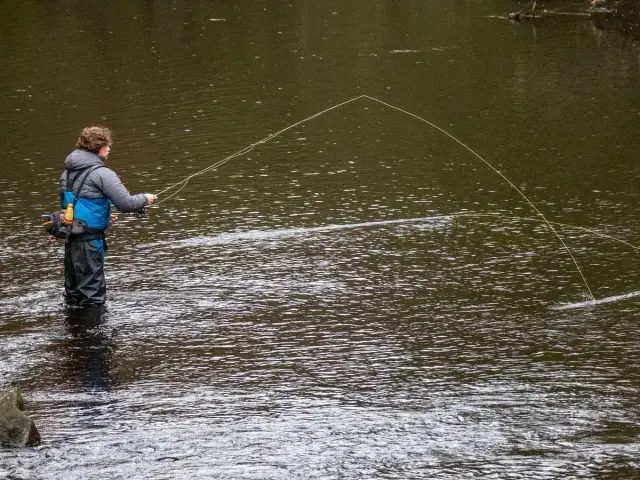
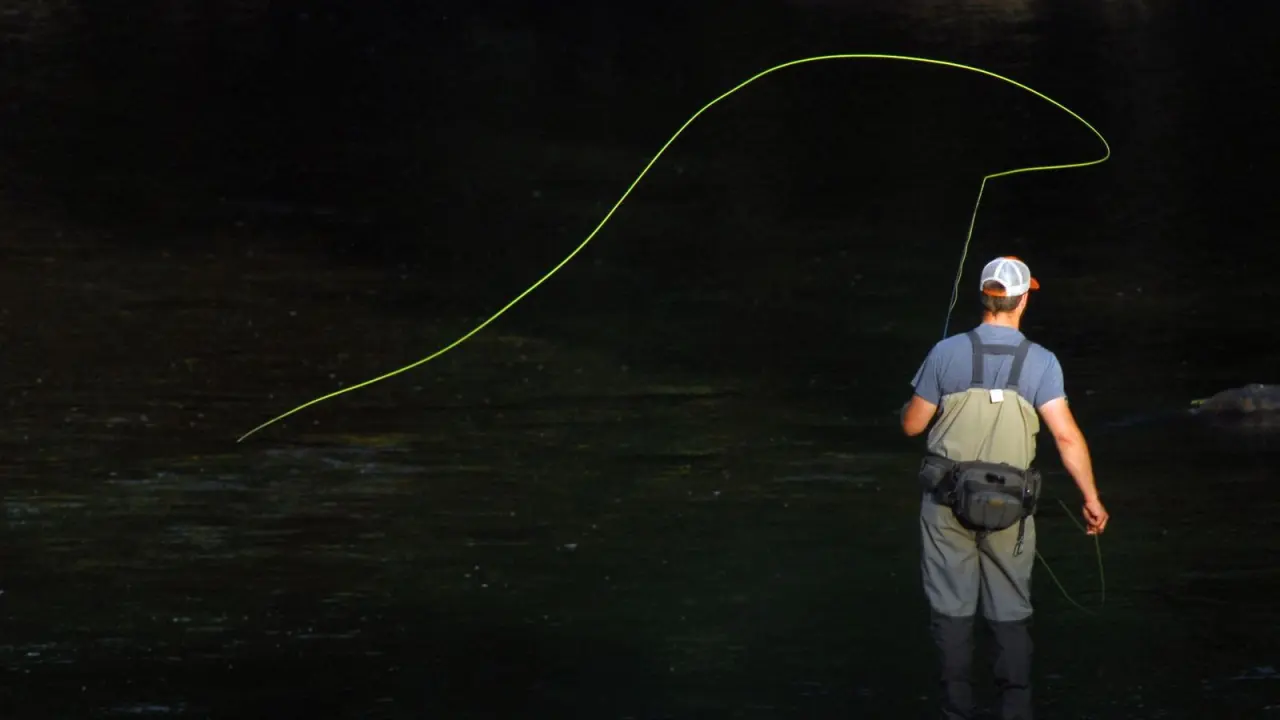
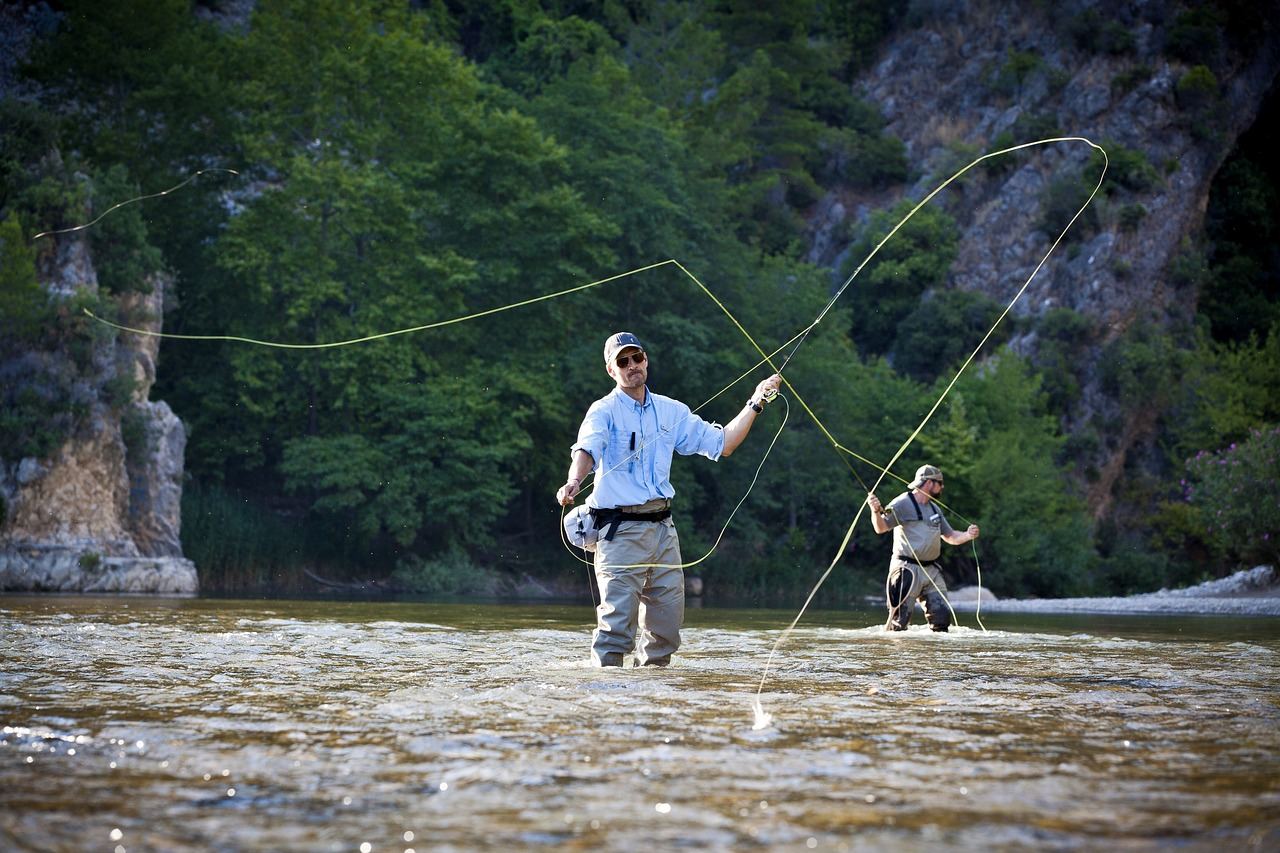
The overhead cast has two main phases, the backcast and the forward cast. According to the Bass Pro Shops guide, the backcast dictates how good the forward cast will be.
- Lift. With the tip low, slowly raise your forearm so the line comes up off the ground.
- Flick. As the rod nears the 10 o’clock position, flick the line upward while squeezing the grip, as the Bass Pro Shops guide describes.
- Stop. Stop the rod at the 2 o’clock position without bending your wrist, so the line loops over you and straightens out behind (same guide).
- Wait. Hold the rod still until the line has fully straightened behind you.
- Deliver. Accelerate quickly toward the target and stop suddenly. Fly Fisherman explains that the quick stop lets the rod unload and propel the line forward.
If the backcast goes badly, the Bass Pro Shops guide suggests you dump the line and restart rather than hope the forward cast rescues it.
Why the rod does the work
Your first goal is to load the rod, which means bending it so the rod does most of the work. Fly Fisherman says too many beginners swing their arms in exaggerated windshield-wiper movements and never really load the rod.
Think of the forward stroke as hammering a nail, with the rod grip as your hammer. Because the rod bends, the tip travels in a straight path toward the target, so your hand should move in a relatively straight path too.
Fly fishing flips the logic of spin casting: you cast the line and the fly follows. That is what allows nearly weightless floating dry flies to be used at all, as the same Fly Fisherman piece points out.
Troutbitten’s author boils it down to the same rule: build speed, and stop hard at two points. He calls lazy casting the most troublesome flaw he sees, and you can read his reasoning in his casting tip.
How long should you pause on the backcast?
There is no magic answer, says the Bass Pro Shops guide. The wait depends on how much line is out and how fast it is travelling, so the fix is practice and attention to detail.
Start forward too soon and the energy of the backcast cancels the forward cast, leaving a tangle. Wait too long and the line drops, so the fly can touch down on the water behind you.
Three simple ways to judge the pause:
- Turn your head and watch the loop straighten. Fly Fisherman says this helps even experts.
- Count down while the line unrolls behind you, a method described in the Bass Pro Shops guide.
- Film your casting, ideally in slow motion on a smartphone, so you can see what is happening behind you.
Do clock positions matter?
Older teaching had beginners swing the arm like a metronome between 10 o’clock and 2 o’clock. Fly Fisherman calls that the old way and says timing and smooth power matter more than clock positions.
Troutbitten treats 10:00 and 2:00 as simply a starting point. If you must put the fly under a tree limb, drift the rod past the level of that limb before delivering the hard stop.
For close casts, a short stroke is enough. Fly Fisherman says the rod then moves just between 1 o’clock and 11 o’clock.
Practice habits that build a reliable cast
Fly Fisherman says 15 minutes of practice every day over a summer or fall season can make you an excellent caster; see the full guide. Short, regular sessions are the goal.
- Practise somewhere open, with nothing overhead to snag your line.
- Film your cast from the side, or ask a friend to, then compare it with the steps above.
- Book a lesson with a qualified instructor through a local fly shop or club, which Fly Fisherman calls the best way to learn.
A friend who fishes may not be a good teacher, because experience does not guarantee they can evaluate your cast. That is why an outside pair of eyes from an instructor is worth the effort.
Rod size changes the details less than you might expect. Troutbitten’s author cast two-weight and seven-weight rods in a few days and found all of them needed speed and abrupt stops. Check a fly line weight chart to match your line to your rod, then apply the same stroke.
Once your casting feels steady, the next skill is tying your connections, and a guide to fly fishing knots is a good place to start.
Frequently asked questions
How far do I need to cast to catch fish?
Show answer
Not far. The Bass Pro Shops guide says a lot of fish are caught between 10 to 30 feet, so master short casts first.
Is the 10 o’clock to 2 o’clock rule wrong?
Show answer
It is a starting point rather than a law. Troutbitten lets the river dictate the angle, and Fly Fisherman puts timing and smooth power ahead of clock positions.
Should I use a lot of wrist?
Show answer
No. Fly Fisherman advises against moving your arm or wrist in an arc, and the Bass Pro Shops guide says to stop the rod at 2 o’clock without bending the wrist. See Fly Fisherman for the straight-path idea.
Can a friend teach me to cast?
Show answer
They can help, but Fly Fisherman warns they may not be good teachers or able to evaluate your cast. A qualified instructor is the better route.
Does my rod weight change how I cast?
Show answer
The principles stay the same: build speed and stop hard. Troutbitten reports that two-weight and seven-weight rods all needed speed and abrupt stops.